
3 similarities between the carbon removal and critical minerals industries
And no, excessive hype is not one of them

The future of human prosperity depends on advances in several emerging technological domains. Two key areas are carbon dioxide removal (CDR) and critical minerals. At first glance, it may not seem like these industries would have many similarities, but they both face challenges related to being hard tech, have competition from riskier alternatives, and can benefit from the same kinds of policy tools. There are opportunities for solutions to shared challenges and for the industries to work together for collective benefit.

Background on CDR and Critical Minerals
CDR is the net extraction and storage of carbon dioxide from the atmosphere to compensate for greenhouse gas emissions and eventually reverse some of the effects of climate change. It is increasingly viewed as a necessary tool to address residual emissions from certain processes that might not be able to decarbonize otherwise, which is required for society to achieve net-zero emissions. It is also the only climate technology that provides the ability to pull back from overshoot of emissions targets.
Approaches to CDR are often classified as “durable” or “engineered” if their carbon storage can be reasonably expected to last for at least hundreds of years, while approaches offering shorter-lived storage on the order of decades are often referred to as “non-durable” or “nature-based.” Examples of durable CDR include direct air capture with storage and enhanced mineralization, and examples of non-durable CDR include reforestation and regenerative agriculture.
Critical minerals are defined by the U.S. Geological Survey (USGS) as minerals “that are essential to the economic or national security of [a country]; have a supply chain that is vulnerable to disruption; and serve an essential function in the manufacturing of a product, the absence of which would have significant consequences for the economic or national security of [a country].” The USGS maintains a list of minerals critical to the United States that at the time of writing has 60 entries including various precious metals, rare earth elements (REEs), common metals like aluminum and lead, and lesser-known elements from the periodic table such as niobium and hafnium. These minerals generally have irreplaceable applications in defense, semiconductors, and energy. Notably, refining and processing critical minerals into useful forms is a part of the value chain that is equally important to the actual mining of these minerals.
The CDR and critical minerals industries are different in many respects. The former is generally viewed as more of a public good while the latter involves the sale of a distinct product to direct customers. The current U.S. administration has a major emphasis on critical minerals but brutally slashed funding and support for CDR. There are also major mining corporations that have mined critical minerals for decades, while the CDR industry is flooded with startups competing for a highly concentrated amount of carbon credit demand.
At the same time, there are important similarities. Three key areas of overlap between CDR and critical minerals offer interesting insights and may even contain broader lessons for scaling other technology-centric industries.
Similarity #1: Hard Tech
The technologies underlying both the CDR and critical minerals industries are classic examples of hard tech, which is also referred to as deep tech, tough tech, or frontier tech. Hard tech is distinct from software in that it requires large investments in the development and scaling of hardware.
While there are numerous “softer” companies in each industry and their respective value chains, CDR and critical minerals at their core are both hard tech areas that involve a significant degree of physical interaction with the natural environment. This results in each industry facing several of the same challenges:
Significant Investment Requirements: Innovations in CDR and critical minerals cannot be scaled up overnight by a couple of programmers in a garage. Both large-scale CDR facilities and mines and processing facilities for critical minerals can easily cost billions of dollars. For example, Phase 1 of the Nevada-based Thacker Pass lithium mine could cost up to $1.6B, while Oxy’s Texas-based STRATOS direct air capture project is estimated to have cost $1.3B.
Long Timelines: Major industrial facilities take years to complete engineering, construction, and commencement. Large CDR facilities, mines, and critical mineral processing facilities are no different, with a caveat that mine development can take even longer than a decade or two. This calls for patient capital that can wait beyond a few-year return timeline.
Need for Industrial Infrastructure: CDR and critical minerals processes do not exist in a vacuum. The engineering, construction, and scaling processes involved in both industries require workforces with requisite skills, appropriate financing and insurance environments, transportation networks to connect sites to broader supply chains, utility networks to supply power and water, and so on. These elements are required across multiple value chain steps, which increases complexity even further.
Corporate and Startup Participation: While the critical minerals industry is much more mature and well-capitalized, it also has startups with novel processes vying for market entry. There are fewer major corporations working directly in CDR, but in each industry both types of companies must work together to discover, finance, and scale innovations in the space.
Chicken-and-Egg Problems: These problems are quite common in hard tech. Oftentimes, they involve some variation of an issue where high costs inhibit deployment but deployment is needed to drive costs down. Solutions often end up involving scraping by with policy support, relying on innovators with a high willingness-to-pay, and creative business acumen. This Substack previously featured an article about chicken-and-egg issues for carbon storage in particular, and many have acknowledged similar issues in the critical minerals industry.
Speed/Scale vs. Environmental/Social Impacts: The risk of running over an already long deployment schedule for projects in both industries often co-exists with the desire to act opportunistically when the political winds are favorable as well as urgent societal needs. This leads to a general mandate for speed and scale in both industries. However, these goals are often in tension with the need to carefully analyze and mitigate environmental risks and the need to engage deeply with communities that will be directly affected by the project. Both the fledgling CDR space and critical minerals industry have invested in community engagement efforts with highly mixed results (and intentions).
Any entrepreneur, or intrapreneur, working in either area will be intimately familiar with the challenges listed above. These may be common across all areas of hard tech, but they are particularly relevant for both CDR and critical minerals.
Similarity #2: Risky Alternatives
CDR and critical minerals share another key similarity: both have cheaper-but-riskier alternatives that tempt buyers on the margins but that are ultimately incompatible with longer-term industrial, strategic, and environmental goals. These alternatives often dominate current markets, offering significant political and market sway if not outright regulatory capture to those who currently benefit from them. This will pose issues if and when countries attempt to wean themselves off these alternatives in favor of “eating their vegetables” by utilizing higher-quality alternatives.
For CDR, many companies and other buyers seeking carbon credits currently end up buying cheap, lower-quality credits that are widely available. These credits represent either emissions reductions from generally suspect counterfactual baselines or CDR that only offers temporary carbon storage. While these widely available credits can provide social and environmental benefits, they are in large part not compatible with net-zero goals.1
For critical minerals, the primary alternative to responsibly and domestically mined products is cheap imports from China or other non-allied or risky countries. While these imports can still meet basic technical and quality specifications, they come with a number of visible and invisible issues and risks. In particular, China’s current domination of global critical minerals production has come at a great environmental, social, and geopolitical cost. According to Goldman Sachs, that cost was a decades-long strategy that relied on “cheaper labor, faster permitting, and looser environmental and labor regulations than in many other countries.”
Another key issue is undesired leverage. A 2018 report from the U.S. Department of Defense observes that China took active steps to solidify its market dominance in REEs and then used this dominance to flex its muscles against reliant countries as it did in a 2010 maritime dispute with Japan. These dependency issues can be invisible and lie in wait until something sparks them, as the current conflict in Iran is making painfully apparent with respect to oil and gas. Despite these issues and risks, however, the lower prices of Chinese minerals serve as a constant temptation for profit-maximizing buyers to default to cheaper sources of critical minerals that pose grave supply chain, environmental, social, and geopolitical concerns.
To incentivize market actors to not default to lower-quality options and instead pursue long-term societal goals (decarbonization for CDR and supply chain security for critical minerals), it is necessary to engage in careful planning and policymaking that acknowledge the complexity of these issues.
Without this, each space risks permanent, irreversible damage. Not having enough high-quality, durable CDR risks deep environmental and societal harm from a hotter climate. Suboptimal critical minerals sourcing puts energy security and therefore national security at risk with additional potential to fall behind in the global race for more powerful artificial intelligence systems. Due to the long timelines and sheer complexity of realizing responsible, at-scale industrial production, more informed private and public action must begin for each space as soon as possible.
Similarity #3: The Policy Toolkit
Due to the similarities between the CDR and critical minerals industries, it is perhaps unsurprising that similar policy toolkits are being proposed and implemented for each one. Markets for each struggle to organically emerge and prosper on their own. Long timelines for implementing capital-intensive facilities, the widespread availability of falsely fungible and risky alternatives, and occasional dependence on by-products from other industries can make it difficult for supply to respond to demand in a timely manner.2 Resolving these kinds of issues and successfully building the necessary markets requires intentional and coordinated work on both the supply and demand sides.
On the supply side, there is a need to foster and grow direct suppliers as well as a broader enabling ecosystem in both industries. In the CDR world, this looks like creating conditions for technology and project developers to emerge, which has already enabled over 700 unique technology and project developers (though significant consolidation is expected). An entire ecosystem of carbon credit marketplaces, registries, brokers, ratings agencies, consultants, and auditors has also emerged to fill out the CDR value chain. The critical minerals landscape also has a number of incumbents and new entrants across the entire mineral life cycle of discovery, exploration, resource extraction, processing, refining, remediation, and recycling, all supported by adjacent industrial value chains.
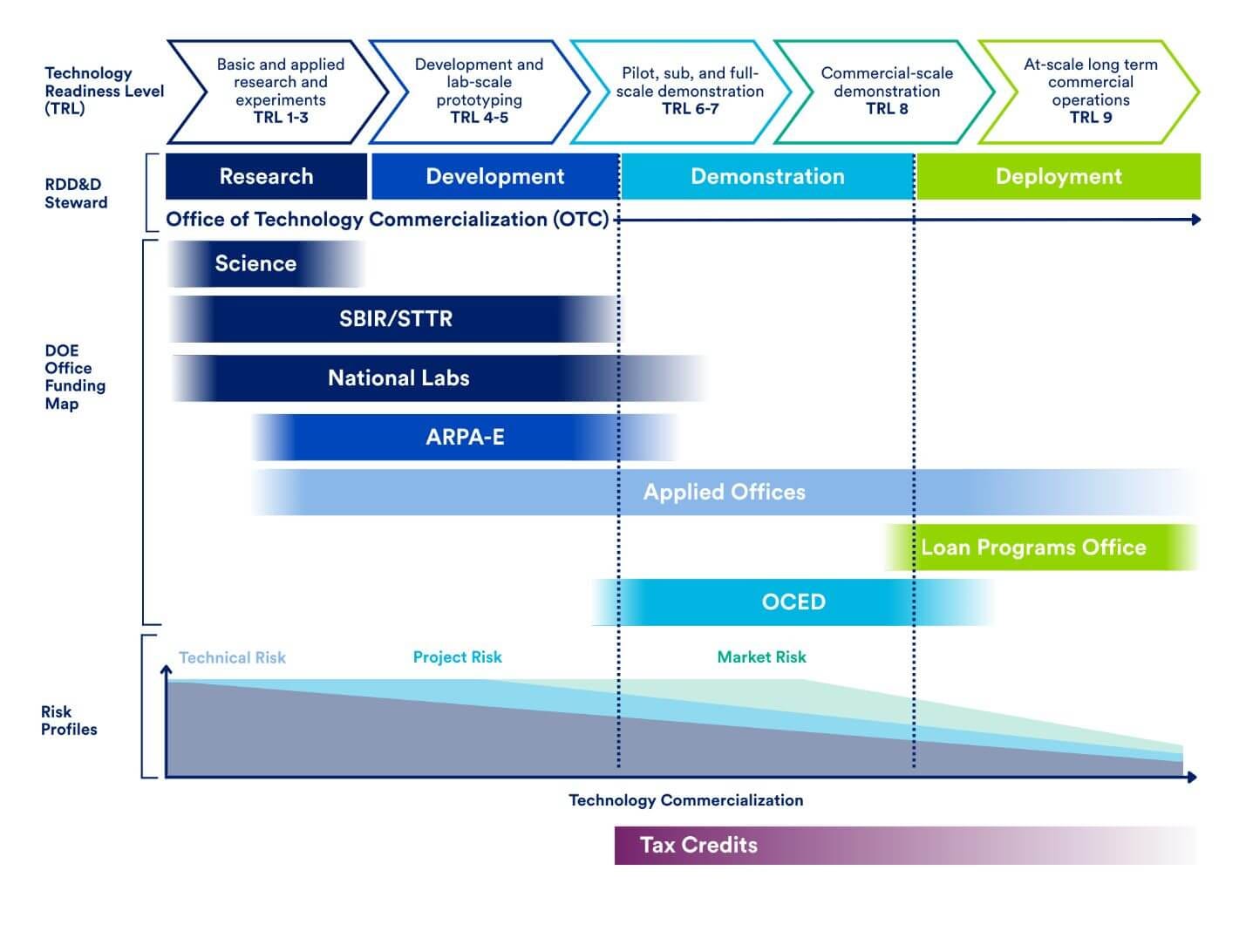
Many of the companies in both industries are either directly or indirectly supported by public funding, with direct support taking the form of research, development, and demonstration funding and indirect support in the form of signaling to private investors. For example, when the U.S. Department of Energy was not quite as dysfunctional, it maintained a strategy of matching types of funding to the technology readiness levels (TRLs) of the technologies moving through the commercialization pipeline. The figure below summarizes this strategy, where low-TRL tech is supported with smaller, high-risk, high-reward funding from basic science offices; mid-TRL tech is supported by more risk-averse, medium-sized funding from applied science offices; and high-TRL tech is supported by very risk-averse but massive investments or loan guarantees from more infrastructure-focused offices.
While different countries will approach this differently with varying levels of dependence on private capital to fund innovation, most supply-side funding will likely leverage similar kinds of government funding tools. This approach can ideally derisk investments and help commercialize high-risk, high-reward ideas for both CDR and critical minerals that might currently be stuck in academic, industrial, or national labs. In addition to technology funding, there is interest in permitting reform, trade policy, hub development, regulatory sandboxes, workforce development, and other areas meant to grease the wheels for suppliers.
However, having a robust ecosystem of suppliers and adjacent value chain players means little without actual demand for what they are selling. Just as there is not enough natural demand for high-quality CDR credits, there is also not enough natural demand for more expensive, domestically sourced critical minerals. Policy plays a fundamental role in creating and entrenching this demand.
There are many proposals for how governments can provide demand-side support. Current ideas for both CDR and critical minerals include direct government procurement, contracts-for-difference, price floors, government backstops for offtake agreements, tax credits, advance market commitments, strategic reserves/stockpiles, and buyers’ clubs. Policies like efficiency requirements that reduce the underlying need for the product can also ease price pressures and thus the fiscal burden of demand-side policies.
Each of these proposals offers a unique value proposition, and different ones will be optimal for different contexts. If it is not possible for durable CDR or critical minerals supply to reach cost parity or the required scale without ongoing policy support, it may be necessary to maintain it in perpetuity. If paid for with public funds, this would pose an ongoing opportunity cost to other social programs, which policymakers would have to work through. Demand-side support also must work in close concert with the scaling of supply. With too much demand support, funds will inefficiently sit unused, and with not enough demand support, companies needed in the long run will go bankrupt today.
Government intervention in markets is often necessary to correct for externalities but also carries risks, especially if the government is subject to regulatory capture by those profiting from the status quo or even outright corruption or incompetence. These risks can result in an inability to meet society’s long-term goals, so those using policy to build CDR and critical minerals markets must engage in holistic systems planning, leverage the power of small experiments, and implement adaptive policies that can dynamically respond to unanticipated changes in the broader environment.
Shared Solutions and Next Steps
The CDR and critical minerals industries share more similarities than one might think. They face similar challenges due to their status as hard tech industries and the availability of cheaper-but-riskier alternatives, which calls for a similar policy toolkit to build markets within each.
There is an opportunity for the communities working in both areas to come together, brainstorm about shared challenges, share learnings and best practices, and perhaps collectively advocate for new developments in hard tech policymaking.
Some solutions are highly likely to be mutually beneficial if implemented. One powerful example would be empowering the U.S. Department of Energy to make full use of Other Transactions Authority (OTA). This could allow the agency to get dollars out of the door more quickly and implement novel demand-side support funding programs. Another example is building the government’s procurement muscle and generally deepening government capacity for industrial policy implementation. Permitting reform and clean tech workforce development are additional types of initiatives that could provide shared benefits. These kinds of advances could ultimately have positive impacts that reverberate out across all sectors of hard tech.
A natural starting point for increased collaboration between these two areas is processes that integrate durable CDR with domestic or allied critical minerals production. Mining can produce enormous quantities of alkaline tailings, and these tailings can be used in enhanced mineralization CDR processes that can increase revenue for mines and possibly remediate toxic tailings. There are yet other processes that involve CDR paired with non-mine production of critical minerals through approaches such as phytomining. For those interested in the intersection of CDR and critical minerals, Arca, Magrathea, Travertine, Metalplant, Exterra, BAIE Minerals, and Winsome Resources are the companies to watch.
The Oxford Principles for Net Zero Aligned Carbon Offsetting and emerging research on Geological Net Zero demonstrate that all positive fossil emissions must either be avoided outright or compensated for with durable CDR for true carbon neutrality. Simply put, planting a tree is not sufficient compensation for burning a barrel of oil. Corresponding recommendations for like-for-like offsetting requirements acknowledge this reality but have yet to be fully incorporated into government policy or Science-Based Targets Initiative standards. Cheap, low-quality credits are too prevalent and entrenched, while higher-quality solutions remain stuck in their chicken-and-egg doom loop.
For example, gallium and germanium are by-products of aluminum and zinc mining respectively, and some CDR technologies may depend on by-products such as agricultural residues, mine tailings, and waste heat.
Good article Grant! You really need to explain how the fundamental difference between mining and CDR - mining is entirely governed by market supply-and-demand, whereas CDR is entirely dependent on government policy - shapes their different structures, especially with regards to funding. A mining company can raise $500 million in private investment if it produces a favourable bankable pre-feasibility study, whereas a CDR company cannot.